
Build with Cerberus.
One handheld. Two processors. A practical reference for writing firmware, connecting peripherals, and creating expansion boards.
Get Cerberus and join the community
Visit the Cerberus store page for board details and ordering. Join the Discord community to discuss firmware, expansion boards, and your builds.
The device, documented.
Cerberus pairs a touchscreen application processor with an independently programmable radio processor. The S3 handles the display, touch, storage, USB, and user interface. The C5 handles radio work and exchanges structured messages over SPI. Different firmware can make use of the same hardware.
Find what you need
Connections at a glance
Base-board GPIOs, built-in interfaces, and the six-C5 expansion pinout.
02 / FIRMWAREProgram both processors
Memory settings, toolchain, protocol, and first-build checks.
03 / EXPANSIONMake room for more
RF/NFC and six-C5 add-ons, both in testing, with a dedicated KiCad file area.
04 / COMPATIBILITYPower it with confidence
Tested batteries and dimensional candidates kept in separate lists.
05 / RFMatch the right antenna
Band coverage, connectors, cables, and repeatable test records.
06 / SUPPORTGet back to building
USB recovery and checks for C5, display, SD, and battery readings.
One base board. Room to expand.
Cerberus uses an S3 N16R2, one onboard C5 with 4 MB flash and no PSRAM, and 1-bit SDMMC with a 40 MHz maximum clock target. The six-C5 bank and RF/NFC board are optional expansion add-ons. Both are in testing.
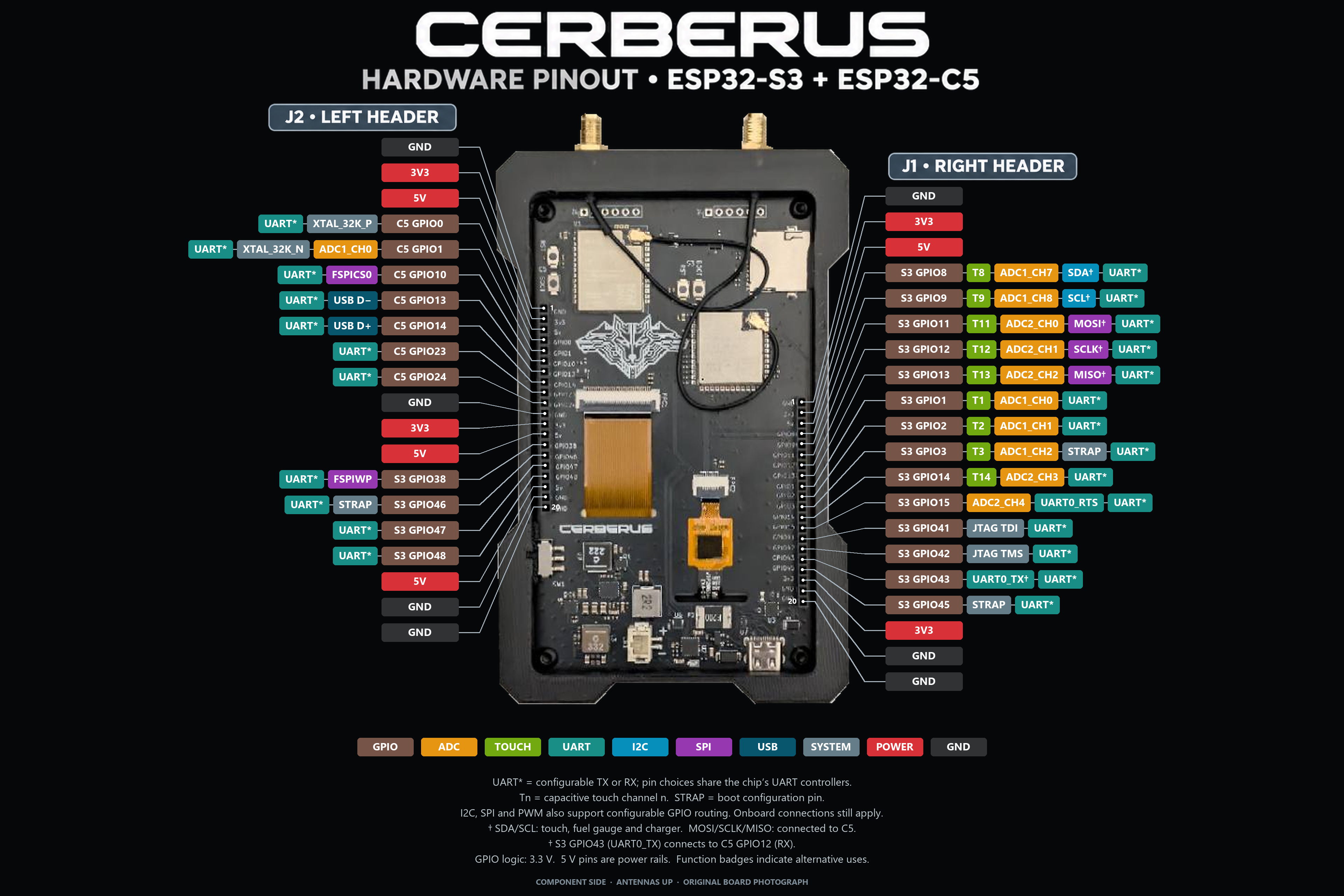
The pinouts page includes the base board, labeled expansion breakout, and six-C5 add-on. The RF/NFC add-on is in early testing; its pin map is not published. See reference and testing for the board reference and add-on status.
Pin assignments, software interfaces, and expansion information are published here. Cerberus main-board design files are excluded.